旅游直播中的情绪与情感体验:参与者隐性与显性表达研究

张奥佳, 肖洪根

人文地理 ›› 2025, Vol. 40 ›› Issue (6) : 30-38, 86.

PDF(13869 KB)
PDF(13869 KB)
人文地理 ›› 2025, Vol. 40 ›› Issue (6) : 30-38, 86. DOI: 10.13959/j.issn.1003-2398.2025.06.004
文化

旅游直播中的情绪与情感体验:参与者隐性与显性表达研究

作者信息 +

EMONTIONAL AND SENTIMENTAL EXPERIENCE IN TOURISM LIVE STREAMING: A STUDY ON IMPLICIT AND EXPLICT EXPRESSION OF PARTICIPANTS

Author information +
文章历史 +

摘要

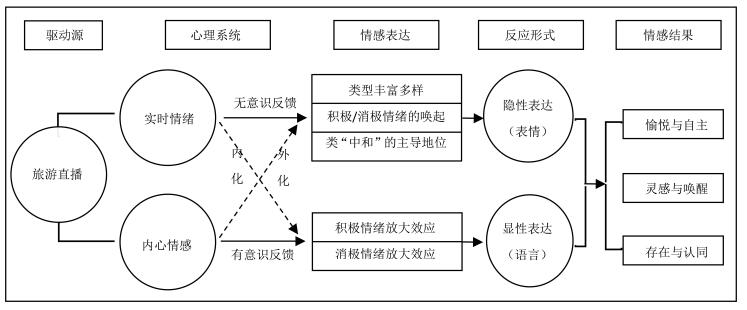
旅游直播作为新兴数字媒介形式,为旅游利益相关者提供了时空同步的情感交互平台。本文基于双过程情感理论,采用表情识别与深度访谈相结合的混合研究设计,系统探讨参与者在直播中的隐性与显性情绪表达及其动态演化过程。研究发现,显性表达倾向回顾加工与积极情绪放大,隐性表达则敏锐捕捉即时情绪波动,尤其在互动密集或情境落差时更为明显。情绪在开场—互动—结尾阶段呈阶段性变化,情感体验体现为“愉悦与自主”“灵感与唤醒”“存在与认同”等核心维度。研究拓展了双过程情感理论在数字旅游场景下的适用边界,揭示了旅游直播中情感表达的结构机理与心理调节路径,为深化虚拟旅游参与者情绪体验理解及平台内容优化提供理论支撑与实证参考。

Abstract

In the context of digital transformation in tourism, tourism live streaming (TLS) has emerged as a novel virtual tourism experience, enabling participants to interact in real time with hosts/KOLs and scenic destinations. Drawing on dual-process theories of emotion, this study develops and validates a conceptual model of emotional and sentimental experience in TLS, integrating both explicit (verbal, self-reported) and implicit (facial expression-based) expression processes. Using a convergent mixed-method design, multimodal data from 41 tourism live streaming informants were collected, including facial emotion recognition via FaceReader software and semi-structured interviews. The results show that implicit expressions effectively captured short-lived and often negative emotions, such as anger or sadness, which were frequently underrepresented in verbal responses. In contrast, participants' self-report tended to highlight positive emotional memories, such as satisfaction, happiness, and inspiration. Dynamic temporal analyses further revealed distinct emotional patterns across three key phases of livestreaming experience: an anticipatory beginning, a peak interaction phase with high emotional volatility, and a reflective ending. These patterns suggest that emotional experience in TLS is phase-dependent and socially constructed through both interaction quality and content resonance. Furthermore, sentimental outcomes are reflected in core dimensions such as "enjoyment and autonomy", "inspiration and arousal", and "existence and identity".
关键词

情绪 / 情感体验 / 虚拟旅游 / 旅游直播 / 面部表情

Key words

emotions / sentimental experience / virtual tourism / tourism live streaming / facial expressions

引用本文

导出引用
张奥佳, 肖洪根. 旅游直播中的情绪与情感体验:参与者隐性与显性表达研究[J]. 人文地理. 2025, 40(6): 30-38, 86 https://doi.org/10.13959/j.issn.1003-2398.2025.06.004
Ao-jia ZHANG, Hong-gen XIAO. EMONTIONAL AND SENTIMENTAL EXPERIENCE IN TOURISM LIVE STREAMING: A STUDY ON IMPLICIT AND EXPLICT EXPRESSION OF PARTICIPANTS[J]. HUMAN GEOGRAPHY. 2025, 40(6): 30-38, 86 https://doi.org/10.13959/j.issn.1003-2398.2025.06.004
中图分类号: F592.7   

参考文献

1
Xiang Z , Fesenmaier D R , Werthner H . Knowledge creation in information technology and tourism: A critical reflection and an outlook for the future[J]. Journal of Travel Research, 2021, 60 (6): 1371- 1376.
2
王馨, 白凯. 临场感对虚拟旅游参与者情感体验的影响——基于时间失真的中介作用和视觉感知的调节效应[J]. 旅游科学, 2023, 37 (2): 155- 174.
Wang Xin , Bai Kai . The effect of presence to emotional experience of virtual tourism participants: Based on the mediating role of time distortion and the moderating effect of visual perception[J]. Tourism Science, 2023, 37 (2): 155- 174.
3
陈俊彤, 殷平. 直播场景下旅游凝视行为研究[J]. 旅游学刊, 2021, 36 (10): 49- 61.
Chen Juntong , Yin Ping . Gazing behavior in response to live streaming tourism[J]. Tourism Tribune, 2021, 36 (10): 49- 61.
4
Lazarus R S . Hope: An emotion and a vital coping resource against despair[J]. Social Research, 1999, 66 (2): 653- 678.
5
潘曙雅, 张煜祺. 虚拟在场: 网络粉丝社群的互动仪式链[J]. 国际新闻界, 2014, 36 (9): 35- 46.
Pan Shuya , Zhang Yuqi . Virtual presence: The interaction ritual chain of online fan community[J]. Chinese Journal of Journalism & Communication, 2014, 36 (9): 35- 46.
6
李春晓, 张宸玮, 李辉, 等. 旅游视频的治愈功效——基于多维情绪测度的对比研究[J]. 旅游科学, 2025, 39 (1): 24- 48.
Li Chunxiao , Zhang Chenwei , Li Hui , et al. The healing effect of tourism videos: A comparative study based on multidimensional emotional measurement[J]. Tourism Science, 2025, 39 (1): 24- 48.
7
孙九霞, 周尚意, 王宁, 等. 跨学科聚焦的新领域: 流动的时间、空间与社会[J]. 地理研究, 2016, 35 (10): 1801- 1818.
Sun Jiuxia , Zhou Shangyi , Wang Ning , et al. Mobility in geographical research: Time, space and society[J]. Geographical Research, 2016, 35 (10): 1801- 1818.
8
陈钢华, 李萌. 旅游者情感研究进展: 历程、主题、理论与方法[J]. 旅游学刊, 2020, 35 (7): 99- 116.
Chen Ganghua , Li Meng . Research on tourist emotions: Development process, topical themes, theories, and methodology[J]. Tourism Tribune, 2020, 35 (7): 99- 116.
9
Groves P M , Thompson R F . Habituation: A dual-process theory[J]. Psychological Review, 1970, 77 (5): 419- 450.
10
黄潇婷, 鞠东辰, 吕兴洋. 神经科学方法在旅游研究中的应用: 一项系统综述[J]. 旅游科学, 2024,
Huang Xiaoting , Ju Dongchen , Lv Xingyang . The application of neuroscience methods in tourism research: A systematic review[J]. Tourism Science, 2024,
11
Zhang S , Chen N , Hsu C H C . Facial expressions versus words: Unlocking complex emotional responses of residents toward tourists[J]. Tourism Management, 2021, 83
12
Scherer K R . The dynamic architecture of emotion: Evidence for the component process model[J]. Cognition and Emotion, 2009, 23 (7): 1307- 1351.
13
Mesquita B, Schouten A. Culture and emotion regulation[M]//Gross J J, Ford B Q. Handbook of Emotion Regulation. New York: The Guilford Press, 2024: 218-224.
14
Keltner D , Sauter D , Tracy J , et al. Emotional expression: Advances in basic emotion theory[J]. Journal of Nonverbal Behavior, 2019, 43 (2): 133- 160.
15
Zhang A , Xiao H . Psychological well-being in tourism live streaming: A grounded theory[J]. Journal of Hospitality & Tourism Research, 2025, 49 (1): 84- 98.
16
黄潇婷. 基于时空路径的旅游情感体验过程研究——以香港海洋公园为例[J]. 旅游学刊, 2015, 30 (6): 39- 45.
Huang Xiaoting . A study of tourists' emotional experience process based on space-time path: A case study of Ocean Park in Hong Kong[J]. Tourism Tribune, 2015, 30 (6): 39- 45.
17
蒋依依, 徐海滨, 张旖旎, 等. 滑雪场认知要素对游客情感的影响研究——以京张地区为例[J]. 人文地理, 2024, 39 (4): 128- 136.
Jiang Yiyi , Xu Haibin , Zhang Yili , et al. Exploring the impact of cognitive factors on tourists' emotions at ski resorts: A case study of Beijing-Zhangjiakou area[J]. Human Geography, 2024, 39 (4): 128- 136.
18
Nawijn J . Determinants of daily happiness on vacation[J]. Journal of Travel Research, 2011, 50 (5): 559- 566.
19
Li S , Walters G , Packer J , et al. Using facial electromyography to test the peak: End rule in tourism advertising[J]. Journal of Hospitality & Tourism Research, 2022, 46 (1): 55- 77.
20
邱林, 郑雪, 王雁飞. 积极情感消极情感量表(PANAS)的修订[J]. 应用心理学, 2008, 14 (3): 249-254, 268.
Qiu Lin , Zheng Xue , Wang Yanfei . Revision of the positive affect and negative affect scale[J]. Chinese Journal of Applied Psychology, 2008, 14 (3): 249-254, 268.
21
武慧慧, 何彪, 胡涛, 等. 照片呈现图式对旅游幸福感的影响研究——基于存在本真性的中介作用和社交媒体强度的调节作用[J]. 旅游科学, 2024, 38 (6): 58- 74.
Wu Huihui , He Biao , Hu Tao , et al. The effects of photo-sharing types on tourist well-being: The mediation role of existential authenticity and the moderation role of social media intensity[J]. Tourism Science, 2024, 38 (6): 58- 74.
22
孟陆, 刘凤军, 陈斯允, 等. 我可以唤起你吗——不同类型直播网红信息源特性对消费者购买意愿的影响机制研究[J]. 南开管理评论, 2020, 23 (1): 131- 143.
Meng Lu , Liu Fengjun , Chen Siyun , et al. Can I evoke you? A study on the influence mechanism of information source characteristics of different types of live broadcasting celebrity on consumers' willingness to purchase[J]. Nankai Business Review, 2020, 23 (1): 131- 143.
23
苏思晴, 吕婷. 云旅游: 基于眼动实验的在线评论对旅游直播体验的影响研究[J]. 旅游学刊, 2022, 37 (8): 86- 104.
Su Siqing , Lv Ting . Virtual tourism: The impact of online comments on experience of tourism live broadcasts based on eye movements[J]. Tourism Tribune, 2022, 37 (8): 86- 104.
24
Deng Z, Benckendorff P, Wang J. Blended tourism experiencescape: A conceptualisation of live-streaming tourism[C]//Pesonen J, Neidhardt J. Information and Communication Technologies in Tourism 2019. Cham: Springer, 2019: 212-222.
25
刘启华, 徐智超, 郭道猛. 旅游景点直播用户参与意愿影响因素研究: 基于信息性社会影响的解释[J]. 海南大学学报(人文社会科学版), 2024, 42 (2): 129- 139.
Liu Qihua , Xu Zhichao , Guo Daomeng . Research into the influencing factors of users' intentions of engaging the live streaming for tourist attractions: An explanation from the informational social influence[J]. Journal of Hainan University (Humanities & Social Sciences), 2024, 42 (2): 129- 139.
26
Chen C C , Lin Y C . What drives live-stream usage intention? The perspectives of flow, entertainment, social interaction, and endorsement[J]. Telematics and Informatics, 2018, 35 (1): 293- 303.
27
罗卉, 张文姣, 梁增贤. 价值共创视角下虚拟旅游直播的观众行为意愿影响机制研究[J]. 旅游论坛, 2024, 17 (4): 30- 41.
Luo Hui , Zhang Wenjiao , Liang Zengxian . The influence mechanism of audience behavioral intention in the context of virtual tourism livestreaming from the perspective of co-creation[J]. Tourism Forum, 2024, 17 (4): 30- 41.
28
Creswell J W . A Concise Introduction to Mixed Methods Research[M]. Thousand Oaks, CA: SAGE Publications, 2014: 2- 9.
29
Chaytor N , Schmitter-Edgecombe M . The ecological validity of neuropsychological tests: A review of the literature on everyday cognitive skills[J]. Neuropsychology Review, 2003, 13 (4): 181- 197.
30
Lewinski P , den Uyl T M , Butler C . Automated facial coding: Validation of basic emotions and FACS AUs in FaceReader[J]. Journal of Neuroscience, Psychology, and Economics, 2014, 7 (4): 227- 236.
31
Denzin N K , Lincoln Y S . The Landscape of Qualitative Research[M]. 3rd ed. Thousand Oaks, CA: SAGE Publications, 2008: 1- 46.
32
陈向明. 扎根理论的思路和方法[J]. 教育研究与实验, 1999, 17 (4): 58-63, 73.
Chen Xiangming . Grounded theory: Its train of thought and methods[J]. Educational Research and Experiment, 1999, 17 (4): 58-63, 73.
33
任莉莉, 刘民坤, 邓小桂, 等. 人—忆—场": 文化融入夜间旅游的内在机理研究[J]. 人文地理, 2024, 39 (4): 160- 170.
Ren Lili , Liu Minkun , Deng Xiaogui , et al. "Person-mermories-scenescapes": A study of the intrinsic mechanism of cultural integration into night tourism[J]. Human Geography, 2024, 39 (4): 160- 170.
34
Calder A J , Young A W . Understanding the recognition of facial identity and facial expression[J]. Nature Reviews Neuroscience, 2005, 6 (8): 641- 651.
35
Mehrabian A. Communication without words[M]//Mortensen C D. Communication Theory. New York: Routledge, 2017: 193-200.
36
Barrett L F . Hypotheses about emotional development in the theory of constructed emotion: A response to developmental perspectives on how emotions are made[J]. Human Development, 2020, 64 (2): 52- 54.
37
王雨晨, 焦育琛, 周文丽. 面面俱到还是欲说还休?旅游直播信息丰富度对旅游消费者实地旅游意愿的影响机制研究[J]. 旅游科学, 2024, 38 (6): 96- 118.
Wang Yuchen , Jiao Yuchen , Zhou Wenli . Give mature consideration to all aspects of a question or say less than you need? A study on the influence mechanism of tourism live streaming information richness on tourism consumers' on-site travel intention[J]. Tourism Science, 2024, 38 (6): 96- 118.
38
李瑞, 郑超, 银松, 等. 民族村寨旅游者主客互动仪式情感体验过程及其唤醒机制研究: 以"高山流水"敬酒仪式为例[J]. 人文地理, 2022, 37 (2): 94- 102.
Li Rui , Zheng Chao , Yin Song , et al. Research on the emotional experience process and arousal mechanism of the host-guest interaction ritual of ethnic village tourists: A case study of "Gaoshanliushui" toasting ritual[J]. Human Geography, 2022, 37 (2): 94- 102.
39
Gratz K L , Roemer L . Multidimensional assessment of emotion regulation and dysregulation: Development, factor structure, and initial validation of the difficulties in emotion regulation scale[J]. Journal of Psychopathology and Behavioral Assessment, 2004, 26 (1): 41- 54.
40
余军, 谢朝武. 电子服务场景如何唤起旅游电商直播观众的购买意愿——基于场所依恋的链式中介模型[J]. 旅游学刊, 2024, 39 (2): 89- 102.
Yu Jun , Xie Chaowu . How e-servicescapes evoke audiences' purchase intention in tourism e-commerce live streaming: The chain mediating effect of place attachment[J]. Tourism Tribune, 2024, 39 (2): 89- 102.

基金

国家重点研发计划重点专项项目(2024YFF0907300)

版权

版权所有,未经授权。
PDF(13869 KB)

Accesses

Citation

Detail

段落导航
相关文章

/