PDF(4324 KB)
 PDF(4324 KB)


 PDF(4324 KB)
红色旅游疗愈生活:自我超越实现机制的质性研究
RED TOURISM HEALING LIFE: A QUALITATIVE STUDY ON THE MECHANISM OF INDIVIDUAL SELF - TRANSCENDENCE
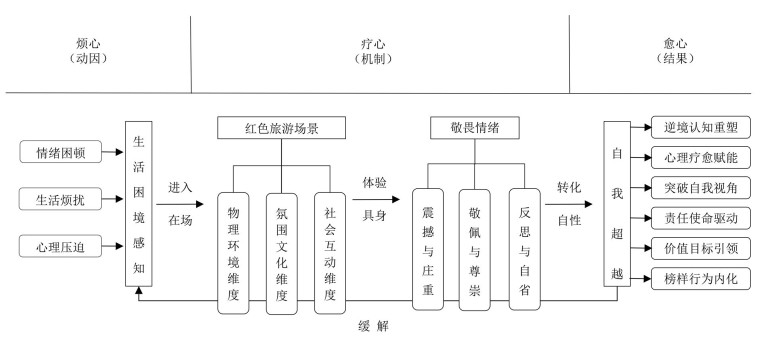
基于旅游疗愈理论,通过深度访谈及扎根理论分析,揭示了红色旅游促进个体自我超越的内在机制。研究发现,红色旅游通过物理环境、氛围文化、社会互动三类场景要素协同作用,触发游客敬畏情绪三维度体验(震撼与庄重、敬佩与尊崇、反思与自省),形成“烦心—疗心—愈心”三阶段演化特征:游客因生活困境感知产生疗愈需求,通过红色旅游场景体验激活敬畏情绪,最终实现认知超越与行为超越。研究构建了“困境感知—场景触发—自我超越”理论模型,验证敬畏情绪在“自我—超我”转化中的中介效应,丰富旅游疗愈理论的文化场景应用。研究从宏观市场定位、中观场景优化、微观体验设计提出管理策略,为红色旅游向深度精神疗愈功能拓展提供理论与实践参考。
Amid growing interest in the psychological benefits of tourism, this study explores how red tourism serves as a cultural healing mechanism that fosters individual self-transcendence. Drawing on tourism therapy theory and employing grounded theory methodology, we conducted in-depth interviews with 21 participants who recently engaged in red tourism and experienced personal distress. Through a three-stage psychological transformation: "vexed mind–healed mind–recovered mind", the study uncovers how red tourism facilitates the emotional and cognitive shift from life frustration to personal growth. Findings indicate that red tourism activates a multidimensional awe experience, which includes shock and solemnity, admiration and reverence, as well as reflection and introspection. This experience emerges through the combined influence of three key scene elements: the physical environment, the cultural atmosphere, and social interaction. Awe serves as a core emotional mediator that connects scene stimuli with cognitive restructuring and prosocial behavioral intentions, ultimately leading to self-transcendence. This emotional journey is not a passive reaction but a dynamic process in which individuals reconstruct meaning, reaffirm their values, and develop a renewed sense of purpose in life. The study builds a theoretical model of "Perceived Dilemmas–Scene Activation–Self-Transcendence, " highlighting the mediating role of awe in the transformation from self-centeredness to collective orientation. Practically, the study proposes strategies at macro (target market positioning), meso (scene design), and micro (emotional-behavioral intervention) levels to support red tourism's shift from ideological education to deep emotional healing. These insights offer both theoretical advancement and practical pathways for designing transformative tourism experiences.
红色旅游 / 旅游疗愈 / 敬畏情绪 / 自我超越 / 质性研究
red tourism / tourism therapy / awe emotion / self-transcendence / qualitative research
| 1 |
张圆刚, 黄业坚, 程静静, 等. 城市居民压力源对幸福感的影响研究: 基于乡村旅游休闲参与的角度[J]. 地理研究, 2019, 38 (4): 971- 987.
|
| 2 |
王淑曼, 李双, 程金龙. 旅游疗愈与心理重建: 压力社会中的自我疗愈之道[J]. 旅游学刊, 2025, 40 (4): 12- 15.
|
| 3 |
|
| 4 |
姜超. 旅行疗愈心理学[M]. 北京: 中国法制出版社, 2022: 143, 167.
|
| 5 |
王咏, 李冬花, 符琳蓉, 等. 红色旅游教育功能的实现: 基于变革性旅游体验的视角[J]. 旅游学刊, 2024, 39 (2): 135- 150.
|
| 6 |
张亮, 李君轶. 基于情境实验的红色旅游恢复性效益及其影响因素分析: 以延安革命纪念馆为例[J]. 旅游学刊, 2024, 39 (7): 143- 156.
|
| 7 |
|
| 8 |
|
| 9 |
|
| 10 |
|
| 11 |
|
| 12 |
Reed P G. Theory of self-transcendence[M]//Smith M J, Liehr P R (Eds.). Middle Range Theory for Nursing (4th ed.). New York: Springer Pub, 2018: 119-146.
|
| 13 |
郭俊伶, 卢东, 金鹏. 红色旅游中敬畏情绪对游客国家认同的影响研究[J]. 资源开发与市场, 2018, 34 (7): 1026- 1031.
|
| 14 |
董锦娜, 王红艳. 红色旅游对红色文化认同的影响机理研究: 基于敬畏情绪的中介[J]. 干旱区资源与环境, 2024, 38 (4): 191- 198.
|
| 15 |
中共中央办公厅, 国务院办公厅. 2004—2010年全国红色旅游发展规划纲要[EB/OL]. 2025-01-08]. https://zfxxgk.ndrc.gov.cn/web/iteminfo.jsp?id=112.
General Office Of The CPC Central Committee & General Office of the State Council. National Outline for the Development of Red Tourism (2004—2010)[EB/OL]. 2025-01-08]. https://zfxxgk.ndrc.gov.cn/web/iteminfo.jsp?id=112.
|
| 16 |
宋瑞, 杨慧. 我国红色旅游政策内容分析与相关建议[J]. 学习与探索, 2024 (8): 154- 162.
|
| 17 |
闫昕, 晏雄, 解长雯, 等. 红色旅游者主观幸福感的链式生成机理研究[J]. 干旱区资源与环境, 2023, 37 (3): 178- 185.
|
| 18 |
程励, 王美玉, 唐凤莲, 等. 红色旅游情境下的情感触点、情感反应与游客认同: 基于5个红色旅游景区样本的实证研究[J]. 旅游学刊, 2023, 38 (7): 52- 69.
|
| 19 |
赵亮, 张智倩. 纪念性旅游场景中敬畏情绪体验对游客国家认同的影响研究[J]. 旅游论坛, 2023, 16 (3): 69- 85.
|
| 20 |
罗景峰, 安虹. 红色旅游沉浸体验的发生机制及意义建构逻辑: 基于双系统理论的视角[J]. 华侨大学学报(哲学社会科学版), 2022 (5): 40- 53.
|
| 21 |
杨振之, 沙莎, 董良泉. 生命质量视域下旅游活动对游客健康影响的研究述评[J]. 旅游科学, 2022, 36 (2): 151- 175.
|
| 22 |
李瑛, 贺文华. 认知性旅游体验对青年旅游者压力后成长的影响: 自我宽恕和人际宽恕的多重链式中介效应研究[J]. 旅游学刊, 2023, 38 (2): 92- 105.
|
| 23 |
杨振之, 沙莎. 旅游疗愈理论: 构成系统与作用机制[J]. 旅游学刊, 2024, 39 (3): 35- 47.
|
| 24 |
熊伟, 罗筱雯, 黄媚娇. 聚焦脆弱人群的旅游疗愈: 相关议题与研究展望[J]. 旅游学刊, 2024, 39 (3): 75- 90.
|
| 25 |
刘佳, 滕金凌. 红色旅游资源开发中敬畏感与自豪感对游客文明旅游行为意向的驱动机制[J]. 自然资源学报, 2021, 36 (7): 1760- 1776.
|
| 26 |
|
| 27 |
赵小红, 童薇, 陈桃林, 等. 敬畏的心理模型及其认知神经机制[J]. 心理科学进展, 2021, 29 (3): 520- 530.
|
| 28 |
|
| 29 |
|
| 30 |
|
| 31 |
|
| 32 |
Nowaczek A M K. The next stage of eco-travel: Facilitating transformation through personal ethics[M]//Reisinger Y. Transformational Tourism: Tourist Perspectives. London: CABI, 2013: 169-179.
|
| 33 |
|
| 34 |
|
| 35 |
|
| 36 |
孙晓娥. 扎根理论在深度访谈研究中的实例探析[J]. 西安交通大学学报(社会科学版), 2011, 31 (6): 87- 92.
|
| 37 |
李慧, 张梦. 红色旅游体验场景量表开发: 一种混合式方法的应用[J]. 旅游科学, 2022, 36 (6): 71- 89.
|
| 38 |
|
| 39 |
|
| 40 |
|
| 41 |
|
| 42 |
|
| 43 |
|
| 44 |
|
| 45 |
|
| 46 |
Haidt J. The moral emotions[M]//Davidson R J, Scherer K R, Goldsmith H H. Handbook of Affective Sciences. New York: Oxford University Press, 2003: 852-870.
|
| 47 |
|
| 48 |
|
| 49 |
|
| 50 |
|
| 51 |
|
| 52 |
|
| 53 |
|
| 54 |
|
| 55 |
|
| 56 |
|
| 57 |
|
| 58 |
|
| 59 |
梁樱. 心理健康的社会学视角: 心理健康社会学综述[J]. 社会学研究, 2013, 28 (2): 220-241, 246.
|
| 60 |
易滢滢, 禹登科. 红色文化氛围对旅游者行为意向的影响: 以敬畏情绪和国家认同为中介[J]. 遵义师范学院学报, 2024, 26 (4): 66- 71.
|
| 61 |
陈奕妙. 敬畏对主观幸福感的影响: 心理韧性和希望感的作用[D]. 呼和浩特: 内蒙古师范大学, 2020: 41-44.
Chen Yimiao. The Influence of Awe on Subjective Well-Being: The Role of Resilience and State Hope[D]. Hohhot: Inner Mongolia Normal University, 2020: 41-44.
|
| 62 |
陈晔, 妥艳媜, 吴迪, 等. 旅行的意义: 大众旅游者自我发展的视角[J]. 人文地理, 2020, 35 (5): 120- 129.
|
| 63 |
马丁. 海德格尔. 存在与时间[M]. 陈嘉映, 王庆节, 译. 北京: 生活· 读书·新知三联书店, 2014: 313, 349.
Heidegger M. Being and Time [M]. Chen Jiaying, Wang Qingjie, trans. Beijing: SDX Joint Publishing Company, 2014: 313, 349.
|
| 64 |
邵德福. 红色旅游实现马克思主义大众化的路径[J]. 社会科学家, 2020 (3): 73- 79.
|
| 65 |
吴志才, 黄诗卉, 张凌媛. 数字人文: 红色旅游发展的新路[J]. 旅游学刊, 2021, 36 (6): 7- 9.
|
| 66 |
焦秋洪, 李功毅. 红色旅游文化的价值本质、嬗变趋势与治理路径[J]. 河南社会科学, 2024, 32 (6): 100- 105.
|
/
| 〈 |
|
〉 |