影像里的旅行者:诗性隐喻与旅游想象的建构

熊伟, 黄晓英, 蔡晓梅

人文地理 ›› 2025, Vol. 40 ›› Issue (5) : 155-164.

PDF(1866 KB)
PDF(1866 KB)
人文地理 ›› 2025, Vol. 40 ›› Issue (5) : 155-164. DOI: 10.13959/j.issn.1003-2398.2025.05.016
旅游

影像里的旅行者:诗性隐喻与旅游想象的建构

作者信息 +

THE TRAVELER IN THE IMAGE: POETIC METAPHORS AND THE CONSTRUCTION OF THE TOURISM IMAGINATION

Author information +
文章历史 +

摘要

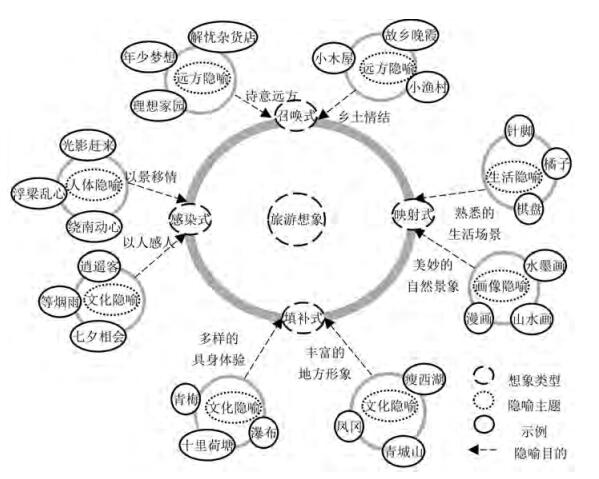
想象已成为游客构建和消费旅游目的地,获得深层旅行体验的重要方式。但已有研究大多从游客视角探讨想象的形成过程,较少关注旅游营销者的角度。本研究受诗性语言和隐喻思维启发,以概念隐喻理论为基础分析旅游视频博客的“作者”如何通过诗性隐喻塑造旅游想象。研究发现:①博主主要通过结构隐喻和本体隐喻塑造旅游想象,且本体隐喻中的文化隐喻、人体隐喻对旅游想象的贡献度最高。②隐喻主题交织塑造出填补式、映射式、感染式和召唤式的旅游想象。③旅游想象的形成过程包括圈层聚集、际遇空间、共同关注和情感共鸣4个阶段。该研究为旅游想象研究提供了中国社会意识形态的微观解构,也为旅游营销者的想象设计提供了实践参考路径。

Abstract

Imagination has become one of the important ways for travelers to construct and consume travel destinations and get a deep travel experience. Inspired by the poetic language and metaphorical thinking of Chinese culture, this study is based on the theory of conceptual metaphor, takes structural metaphor, ontological metaphor and orientation metaphor as the analytical framework for metaphor recognition, and identifies the poetic metaphor theme in the travel video blog texts through the MIPVU program, and studies how the "author" of travel video blogs shape tourism imagination through poetic metaphors. Through the coding analysis of 292 travel video blog texts, the results show that: 1) The tourism imagination shaped by bloggers mainly includes two types of metaphors: structural metaphor and ontological metaphor. 2)The metaphors of different themes are intertwined, and finally four kinds of tourism imaginations are formed: filling, mapping, contagious, and summoning. 3) Tourism imagination is formed through four stages: circle gathering, encounter space, common concern and emotional resonance.
关键词

旅游想象 / 诗性隐喻 / 旅游叙事 / 情感共鸣 / 旅游视频博客

Key words

tourism imagination / poetic metaphors / travel narrative / emotional resonance / travel video blogs

引用本文

导出引用
熊伟, 黄晓英, 蔡晓梅. 影像里的旅行者:诗性隐喻与旅游想象的建构[J]. 人文地理. 2025, 40(5): 155-164 https://doi.org/10.13959/j.issn.1003-2398.2025.05.016
Wei XIONG, Xiao-ying HUANG, Xiao-mei CAI. THE TRAVELER IN THE IMAGE: POETIC METAPHORS AND THE CONSTRUCTION OF THE TOURISM IMAGINATION[J]. HUMAN GEOGRAPHY. 2025, 40(5): 155-164 https://doi.org/10.13959/j.issn.1003-2398.2025.05.016
中图分类号: F592   

参考文献

1
冷凇. "人间烟火"的景象迁移与"现实图景"的双向建构——新冠肺炎疫情下短视频与拟态环境重构[J]. 新闻与传播研究, 2020, 27(9): 111-125, 128.
Leng Song. The "human fireworks" scene migration and the two-way construction of "realistic prospect"[J]. Journalism & Communication, 2020, 27(9): 111-125, 128.
2
NelsonG, 撒露莎. 旅游想象: 关于旅游目的地的形象认知[J]. 中南民族大学学报(人文社会科学版), 2019, 39(1): 58- 63.
Nelson G, Sa Lusha. Tourism imagination: Image cognition of tourist destinations[J]. Journal of South-Central Minzy University (Humanities and Social Sciences Edition), 2019, 39(1): 58- 63.
3
乌铁红, 韩秋晨. 幻与实: 寻"家"旅途中的地理想象与景观感知[J]. 旅游学刊, 2021, 36(11): 3- 5.
Wu Tiehong, Han Qiuchen. Illusion and reality: Geographical imagination and landscape perception in the journey of searching for "Home"[J]. Tourism Tribune, 2021, 36(11): 3- 5.
4
Le D, Scott N, Wang Y. Impact of prior knowledge and psychological distance on tourist imagination of a promoted tourism event[J]. Journal of Hospitality and Tourism Management, 2021, 49, 101- 111.
5
Li Y W, Wan L C. Inspiring tourists' imagination: How and when human presence in photographs enhances travel mental simulation and destination attractiveness[J]. Tourism Management, 2025, 106, 104969.
6
SalazarN B, 张进福, BuntenA C, 等. 中国旅游发展笔谈——旅游与社会文化变迁(二)[J]. 旅游学刊, 2013, 28(12): 3- 14.
Salazar N B, Zhang Jingfu, Bunten A C, et al. Discussion forum of tourism development: Tourism and sociocultural change(Ⅱ)[J]. Tourism Tribune, 2013, 28(12): 3- 14.
7
杨位擎, 罗秋菊. 自媒体语境下海外受众对中国的地理想象建构——以YouTube李子柒短视频受众为例[J]. 人文地理, 2024, 39(1): 8-16, 67.
Yang Weiqing, Luo Qiuju. Research on geographical imagination of China in the context of we media: Taking the overseas audiences of Li Ziqi's short video on YouTube as an example[J]. Human Geography, 2024, 39(1): 8-16, 67.
8
周永博, 蔡元. 从内容到叙事: 旅游目的地营销传播研究[J]. 旅游学刊, 2018, 33(4): 6- 9.
Zhou Yongbo, Cai Yuan. From content to narrative: Research on tourism destination marketing communication[J]. Tourism Tribune, 2018, 33(4): 6- 9.
9
Pan B, Maclaurin T, Crotts J C. Travel blogs and the implications for destination marketing[J]. Journal of Travel Research, 2007, 46(1): 35- 45.
10
Bosangit C, Dulnuan J, Mena M. Using travel blogs to examine the postconsumption behavior of tourists[J]. Journal of Vacation Marketing, 2012, 18(3): 207- 219.
11
Ghosh T, Sarkar A. "To feel a place of heaven": Examining the role of sensory reference cues and capacity for imagination in destination marketing[J]. Journal of Travel & Tourism Marketing, 2016, 33(1): 25- 37.
12
Duffy A. If I say you're authentic, then you're authentic: Power and privilege revealed in travel blogs[J]. Tourist Studies, 2019, 19(4): 569- 584.
13
Chronis A. Between place and story: Gettysburg as tourism imaginary[J]. Annals of Tourism Research, 2012, 39(4): 1797- 1816.
14
Van Driel L, Dumitrica D. Selling brands while staying "Authentic": The professionalization of Instagram influencers[J]. The International Journal of Research into New Media Technologies, 2021, 27(1): 66- 84.
15
翁时秀. "想象的地理"与文学文本的地理学解读——基于知识脉络的一个审视[J]. 人文地理, 2014, 29(3): 44-49, 160.
Weng Shixiu. Imaginative geographies and the geographical reading of literature texts: A review based on geographical publications[J]. Human Geography, 2014, 29(3): 44-49, 160.
16
乔治·莱考夫, 马克·约翰逊. 我们赖以生存的隐喻[M]. 何文忠, 译. 杭州: 浙江大学出版社, 2015: 11, 23, 61.
Lakoff G, Johnson M. Metaphors We Live By[M]. He Wenzhong, trans. Hangzhou: Zhejiang University Press, 2015: 11, 23, 61.
17
Lakoff G, Turner M. More than Cool Reason: A Field Guide to Poetic Metaphor[M]. Chicago: The University of Chicago Press, 1989: 136.
18
丁毅伟. 诗性隐喻的文化认知阐释[J]. 湖北社会科学, 2016(11): 111- 115.
Ding Yiwei. Cultural cognitive interpretation of poetic metaphor[J]. Hubei Social Sciences, 2016(11): 111- 115.
19
Yu X, Xu H. Ancient poetry in contemporary Chinese tourism[J]. Tourism Management, 2016, 54, 393- 403.
20
Xu H, Cui Q, Ballantyne R, et al. Effective environmental interpretation at Chinese natural attractions: The need for an aesthetic approach[J]. Journal of Sustainable Tourism, 2013, 21(1): 117- 133.
21
Wei C, Dai S, Xu H, et al. Cultural worldview and cultural experience in natural tourism sites[J]. Journal of Hospitality and Tourism Management, 2020, 43, 241- 249.
22
林铭亮, 高川秀, 林元城, 等. 旅游地品牌化: 唐诗"第三空间"的旅游体验与地方想象的建构[J]. 旅游学刊, 2020, 35(5): 98- 107.
Lin Mingliang, Gao Chuanxiu, Lin Yuancheng, et al. Place-branding of tourist destinations: The construction of the "third space" tourism experience and place imagination from Tang poetry[J]. Tourism Tribune, 2020, 35(5): 98- 107.
23
张兴泰, 陈志钢, 张骁鸣, 等. 流动与想象: 西藏地方意义的多元互构研究[J]. 地理研究, 2021, 40(8): 2292- 2313.
Zhang Xingtai, Chen Zhigang, Zhang Xiaoming, et al. Liquidity and imagination: A study of multiple mutual-construction of Tibetan place meaning[J]. Geographical Research, 2021, 40(8): 2292- 2313.
24
安宁, 朱竑. 他者, 权力与地方建构: 想象地理的研究进展与展望[J]. 人文地理, 2013, 28(1): 20-25, 47.
An Ning, Zhu Hong. Otherness, power and the construction of place: Towards a theoretical and empirical reassessment of imaginative geography[J]. Human Geography, 2013, 28(1): 20-25, 47.
25
殷洁, 王静雅. 发展型城市政体主导的城市游憩商业区空间生产研究——以西安大唐不夜城为例[J]. 人文地理, 2022, 37(5): 71- 79.
Yin Jie, Wang Jingya. Research on the space production of recreational business district dominated by developmental urban regime: A case study of Xi'an Great Tang all day mall[J]. Human Geography, 2022, 37(5): 71- 79.
26
马凌. 诗意地迂回: 诠释现象学视角下的主体想象与旅游体验[J]. 旅游学刊, 2022, 37(10): 39- 49.
Ma Ling. The journey of poetic detour: On the imagination of tourists and their tourism experiences[J]. Tourism Tribune, 2022, 37(10): 39- 49.
27
Yang Z T, Ruan W Q, Zhang S N, et al. Revealing the metaphorical code: Heterogeneous effects and mechanisms of tourism advertising style in cultural heritage sites[J]. Journal of Hospitality and Tourism Management, 2024, 59, 263- 275.
28
Zhang Q, Xu H, Cheng J. Do not blame the "bad" weather: Stimulating its poetic aesthetics in nature-based tourism destinations[J]. Tourism Management, 2023, 98, 104774.
29
Yu X, Xu H. Moral gaze at literary places: Experiencing "being the first to worry and the last to enjoy" at Yueyang Tower in China[J]. Tourism Management, 2018, 65, 292- 302.
30
陈朗. 从MIP到MIPVU: 识别的方法、应用与问题[J]. 外语学刊, 2022(5): 30- 39.
Chen Lang. From MIP to MIPVU: Identification methods, applications, and issues[J]. Foreign Language Research, 2022(5): 30- 39.
31
刘涛. 解读伊瑟尔的"召唤结构"[J]. 文艺评论, 2016(3): 56- 60.
Liu Tao. Interpretation of Iser's "summoning structure"[J]. Literature and Art Criticism, 2016(3): 56- 60.
32
钱俊希, 张瀚. 想象、展演与权力: 西藏旅游过程中的"他者性"建构[J]. 旅游学刊, 2016, 31(6): 82- 93.
Qian Junxi, Zhang Han. Imagination, performance and power: The construction of otherness in Tibetan tourism[J]. Tourism Tribune, 2016, 31(6): 82- 93.
33
苏晓波. 他乡变故乡: 丽江生活方式型旅游移民"家"的归属与疏离研究[J]. 旅游学刊, 2022, 37(9): 14- 26.
Su Xiaobo. From one home to another: Lifestyle migration and the belonging and alienation of home in Lijiang[J]. Tourism Tribune, 2022, 37(9): 14- 26.
34
王晓萍. 隐喻产生和理解的机制[J]. 广东社会科学, 2016(3): 60- 67.
Wang Xiaoping. Mechanisms of metaphor generation and understanding[J]. Social Sciences in Guangdong, 2016(3): 60- 67.
35
巩述林. 圈层化语境下网生代"中老年"表情包传播实践与话语重构[J]. 未来传播, 2023, 30(6): 49- 58.
Gong Shulin. Communication practice and discourse reconstruction of "Middle-aged and Elderly" emoji in the internet generation in the context of circulation[J]. Future Communication, 2023, 30(6): 49- 58.
36
Milazzo L, Santos C A. Fanship and imagination: The transformation of everyday spaces into Lieux D' magination[J]. Annals of Tourism Research, 2022, 94, 103399.
37
胡壮麟. 认知隐喻学[M]. 北京: 北京大学出版社, 2020: 87.
Hu Zhuanglin. Cognitive Metaphorology[M]. Beijing: Peking University Press, 2020: 87.
38
吴恒, 何文俊. 因何而美: 旅游审美体验的溯源与机制[J]. 旅游学刊, 2022, 37(1): 99- 108.
Wu Heng, He Wenjun. Why we find it beautiful: A reflection on tourism aesthetic experience and research on its mental mechanisms[J]. Tourism Tribune, 2022, 37(1): 99- 108.
39
郑洁萍, 李浩纯. 互动仪式链视域下主流媒体短视频的共情传播策略分析——以人民日报抖音号为例[J]. 科技传播, 2022, 14(22): 126-128, 132.
Zheng Jieping, Li Haochun. Empathy communication strategy analysis of mainstream media short videos from the perspective of Interactive Ritual Chain: A case study of Douyin number of People's Daily[J]. Public Communication of Science & Technology, 2022, 14(22): 126-128, 132.
40
李晶. 第三空间视阈下移动短视频的空间特征、建构逻辑与正义实现[J]. 当代电视, 2021(12): 4- 9.
Li Jing. Spatial characteristics, construction logic and justice realization of moving short video under the third spatial visual threshold[J]. Contemporary TV, 2021(12): 4- 9.
41
Hur S, Lim H, Lyu J. "I" or "She/He"? The effects of visual perspective on consumers' evaluation of brands' social media marketing: From imagery fluency perspective[J]. Journal of Global Fashion Marketing, 2020, 11(1): 1- 17.
42
Xu D, Chen T, Pearce J, et al. Reaching audiences through travel vlogs: The perspective of involvement[J]. Tourism Management, 2021, 86, 104326.
43
黄华新. 认知科学视域中隐喻的表达与理解[J]. 中国社会科学, 2020(5): 48-64, 205.
Huang Huaxin. The expression and understanding of metaphors from the perspective of cognitive science[J]. Social Sciences in China, 2020(5): 48-64, 205.
44
Cohen J. Defining identification: A theoretical look at the identification of audiences with media characters[J]. Mass Communication and Society, 2001, 4(3): 245- 264.
45
王文斌. 隐喻的认知构建与解读[M]. 上海: 上海外语教育出版社, 2007: 157- 158.
Wang Wenbin. Cognitive Construction and Interpretation of Metaphors[M]. Shanghai: Shanghai Foreign Language Education Press, 2007: 157- 158.
46
Larson M, Lundberg C, Lexhagen M. Thirsting for vampire tourism: Developing pop culture destinations[J]. Journal of Destination Marketing & Management, 2013, 2(2): 74- 84.
47
邝子然, 林耿. 视觉化时代"网红打卡"的消费实践与空间生产——以电影《少年的你》及其取景地重庆为例[J]. 旅游学刊, 2024, 39(2): 74- 88.
Kuang Ziran, Lin Geng. Consumption practices and production of space at Internet-famous locations in the era of visualization: A case study of Better Days and its film location Chongqing[J]. Tourism Tribune, 2024, 39(2): 74- 88.
48
刘沛林, 刘瑞瑞, 邓运员, 等. 想象与流动: "第三空间"的旅游体验与地方意义建构——以凤凰古城短居旅游者为例[J]. 人文地理, 2023, 38(6): 15-22, 124.
Liu Peilin, Liu Ruirui, Deng Yunyuan, et al. Imagination and mobility: Tourism experience and construction of local meaning in the "third space": A case study of Fenghuang ancient town[J]. Human Geography, 2023, 38(6): 15-22, 124.
49
Hosany S, Buzova D, Sanz-Blas S. The influence of place attachment, ad-evoked positive affect, and motivation on intention to visit: Imagination proclivity as a moderator[J]. Journal of Travel Research, 2020, 59(3): 477- 495.
50
Khalilzadeh J, Pizam A, Fyall A, et al. Destination imagination: Development of the octomodal mental imagery (OMI) scale[J]. Tourism Management Perspectives, 2023, 45, 101051.
51
Karl M, Kock F, Bauer A, et al. When the future is now: An experimental study on the role of future thinking and affective forecasting in accommodation decision-making[J]. Journal of Travel Research, 2023, 62(5): 969- 988.
52
曹诗图, 孙天胜, 周德清. 旅游审美是诗意的对话——兼论中西哲学思想中的审美观[J]. 旅游论坛, 2011, 4(2): 115- 118.
Cao Shitu, Sun Tiansheng, Zhou Deqing. Tourism aesthetics as a poetic dialogue: Aesthetic view in the theory of Chinese and western philosophy[J]. Tourism Forum, 2011, 4(2): 115- 118.
53
Salazar N B. Tourism imaginaries: A conceptual approach[J]. Annals of Tourism Research, 2012, 39(2): 863- 882.
54
Zhang Q, Xu H. Understanding aesthetic experiences in naturebased tourism: The important role of tourists' literary associations[J]. Journal of Destination Marketing & Management, 2020, 16, 100429.

基金

国家自然科学基金面上项目(42571306,42371239);广东省普通高校哲学社会科学重点实验室项目(2022WSYS004)

版权

版权所有,未经授权,不得转载。
PDF(1866 KB)

Accesses

Citation

Detail

段落导航
相关文章

/